
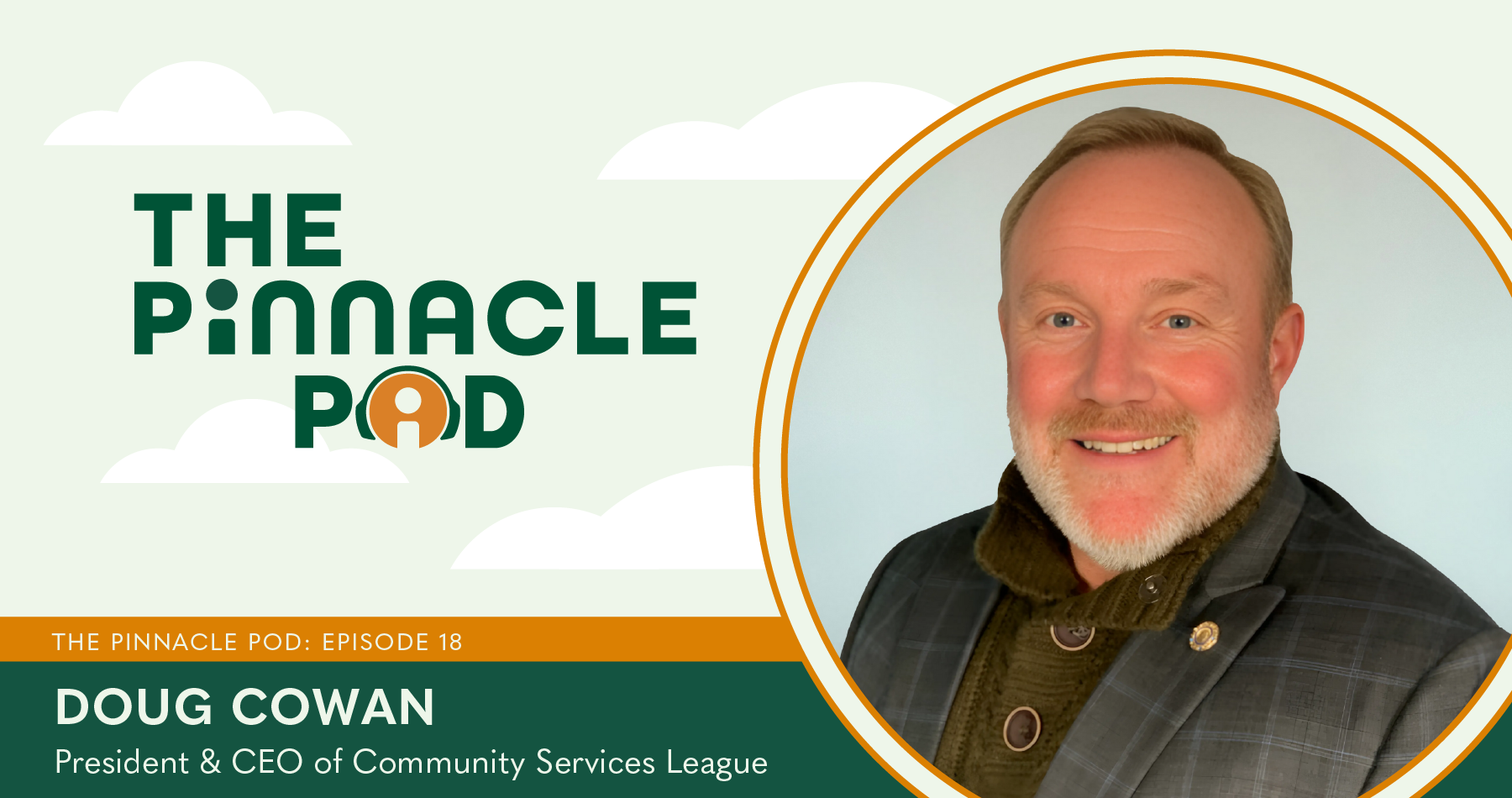
What does it mean to truly belong to a community? In this episode of The Pinnacle Pod, Doug Cowan, president and CEO of Community Services League, reflects on the gravitational pull that called him to serve the community he has always called home. He shares why knowing a community begins with knowing its people, how leading with heart creates space for others to contribute, and why meaningful progress rarely happens through one person or organization alone. Through stories of neighbors, young people, families, and unexpected partnerships, Doug offers an inspiring reminder that strengthening Kansas City starts with being present, staying open and asking a simple question: what can I do to help?


Transcript
Tracy McFerrin:
Welcome back to The Pinnacle Pod, the voice of The Pinnacle Prize, an annual prize recognizing people making a significant impact on Kansas City through bold, selfless actions. I am Tracy McFerrin, your host as we meet dynamic leaders who show us what’s possible when passion meets perseverance. Today, I am excited to welcome Doug Cowan, president and CEO of Community Services League, which we will call CSL in this podcast. CSL is a nonprofit organization that has served Eastern Jackson County for more than 110 years. Doug is a longtime resident of Independence, Missouri, and believes deeply in the power of communities working together to create opportunities for their neighbors. That connection to independence has been a major catalyst for his work and fuels his commitment to building stronger pathways to economic mobility. Throughout his career, he has championed partnerships between nonprofits, schools, businesses, funders, and local governments, recognizing that lasting change happens when communities collaborate rather than work in silos. Since becoming CEO of CSL in 2013, he has helped mold the organization into a comprehensive community development superpower in the Kansas City region, focused on long-term stability, opportunity, and upward mobility for families. Under his leadership, CSL has expanded programs in financial coaching, workforce development, wealth and asset building, housing stability, and career training. Doug, welcome to the Pinnacle Pod.
Doug Cowan:
It is so great to be here with you.
Tracy McFerrin:
Let’s dig in. I just gave a mouthful of <laugh> things that CSL is up to. Your work with CSL has become really well known, not just in independence, but across the Kansas City region. What first inspired you to dedicate your career to community development and helping families build economic stability?
Doug Cowan:
Well, that’s a great question, and I’ll answer it with a little bit of a story. So I am a fundraiser by trade, and coming out of the University of Missouri, I had a chance to work with a fundraising consulting firm. We worked in that firm. We worked specifically to support fraternity and sorority alumni groups on major college campuses to run major capital campaigns. So think Big 10, Big 12, SEC type schools. And we would lead the whole campaign. We’d structure the volunteer infrastructure for the campaign. We’d make the major gift solicitations. We handled all of their marketing and direct mail pieces in the campaign. So it was six years of really great experience in fundraising. But I was in my 20s at the time and I was commuting from Independence, Missouri to Lawrence, Kansas every day and traveling across the country to support clients. And I didn’t really have my pulse on what was going on in our communities and how my skills would be transferable. So there was just a point in time, maybe you can call it the seven-year itch. I remember driving back and forth and I just literally felt a gravitational pull of you’ve got to do something in your community. Gotta be something, take these skills and go do some work. And some of my colleagues at Pennington & Company had made successful transitions from leading these large scale campaigns to director of development roles. And literally I just responded to a nonprofit connect job link post about the director of development role at Community Services League. And I had a few ties to the organization. Interestingly, my twin brother and I are both Eagle Scouts and he did his Eagle Scout project, which was a neighborhood collection of Christmas toys for Community Services League. This would’ve been around 1995 or so. And my mom is a longtime educator and high school and middle school counselor. And so she would oftentimes work with kids in challenging situations. And I think she made a lot of calls to the CSL office in Independence. <laugh> So I had some overlap and in fact, I, I served as, for a very brief period of time my senior year in high school as a student liaison between Truman High School and Independence where I was and the Community Services League board of directors. So I had these few little engagements with CSL along the way. And so it kind of pulled it all together, but there was just this gravitational pull of doing something in my hometown, the community that I loved, that I still love and, and where we’re living and raising our children. And so it’s just one of those sort of poetic collaborations that came together in life.
Tracy McFerrin:
Right. That’s so powerful to live and work and work where you live. I think that you can make such a powerful connection because you really get to know the community really well that way. You’re steeped in it.
Doug Cowan:
You do. You know the community because you know the people. Right. And today our family, we live on Main Street in the historic Independence Square. So we’re just eight blocks south of the square, uh, which for any community is, it tends to be the heartbeat of, of that community. And so it, it has put me for the last 17 years right in the middle of everything. So while I don’t know everyone’s story and I don’t claim to be perfect, being there in the middle of our community gives me a, a good pulse on what’s going on. And so when you feel connected and invested in your community, you are invested in our neighbors and what are their life outcomes? These are the people that you see at the grocery store. These are the people that you go to school with. These are the people that you work with. They’re the people you go to church with. They’re the people you do life with. And you can’t help, but as a human being, but anything else other than wanting what is the very best for them and for them to reach their potential.
Tracy McFerrin:
Well, when you became CEO of CSL in 2013, the organization was approaching its 100th anniversary. What was your vision then and how has that vision evolved over the last decade?
Doug Cowan:
Well, I know it might make for a good podcast for me to come here and tell you that I had this grand vision and that we had all these steps to take. I remember walking in, it was March 13th of 2013 and, and the organization had such a, a good run up. It was 97 years old at that time and a lot of great things going for it. However, we had some instability at the chief executive level. Over the last five or six years, or the five or six years prior, there had been kind of a revolving door, a couple of people with the role permanently, a couple of interim folks who all had done a nice job, but there had not been a lot of stability in the role. And so what I told myself walking in, I can even still see myself walking in the back door into my office area was, you know what? In the absence of any other good strategy, my main job was to be present and to help build strong culture within the organization. So those were the two things that I set out to do, were to be a present and invested leader and to help build positive culture within the team. And so that’s where we started from.
Tracy McFerrin:
Well, let’s talk about some of the programs of CSL. Workforce development, it’s become a major focus for the organization. What’s the biggest barriers preventing people from accessing quality careers and how can communities help remove those barriers?
Doug Cowan:
When I started at CSL, the organization was primarily focused on emergency relief, food, clothing, shelter, things like that. And we did have three people in a program that we called Work Express. And as the name would imply, the goal was to get people into work quickly. Any job, let’s get you a job. And that was great work. However, reflecting back, it wasn’t changing the long-term trajectory for families. So what really changed the course for us in this work was in 2015, we received here in Kansas City from our partners at LISC of Greater Kansas City. LISC is Local Initiative Support Corporation. We received a designation as a financial opportunity center. And that put us in a network, not only here in Kansas City, but throughout the country of organizations that embed financial coaching into their work. And the other big program that they gave us a roadmap of how to implement was called Bridges to Career Opportunities. And all of a sudden it was like our eyes opened about what was possible. And so we really scrapped the Work Express model. Even though that getting people into jobs quickly, having that paycheck is a very noble and good work, we saw what if we could give people career trainings for free that would break generational cycles of poverty? And I remember distinctly, we partnered with, of course, LISC, who gave us this model of how to build the program. And the model’s really centered around getting that industry recognized credential in a fairly short amount of time so that families don’t have to, they don’t have the luxury of quitting their life for three to four years and going back to school. They need something quick that’s gonna give them that certificate that makes them an attractive candidate. We also want a certificate that is stackable and we want that to be, you know, some, a career that they can continue to grow into. And so we looked at, well, what was possible? And the City of Independence had some expiring community development block grant money and that, those dollars to invest in a CNA training program. CNA, of course, being certified nursing assistant. It really is the first step into healthcare trade. And entry level gets you into a hospital setting, a long-term care facility, whatever it might be, and then you can stack going up and up. And so it was tremendously successful. We had 15 in the class. We graduated 14. They all got jobs and we though, oh my gosh, we are onto something here. And so it really was just, just unbelievable circumstances of events and partners that brought resources and programmatic models and we helped mash it together to create something that has now been long-lasting. And, and to kind of wrap up this though, last year we celebrated that had been our 10th year of operating Bridges to Career Opportunities. And we had graduated more than 700 people with an industry recognized credential at a grand whopping total of zero dollars to the participants. We use philanthropy dollars and other partnerships to enroll people into these training programs. They go to community colleges, private training operators at no cost, those that have the, uh, ability to give out the industry recognized credential. So we started with this one cohort of 15 students in a CNA program and a decade later, more than 700 graduates.
Tracy McFerrin:
Very impressive. You mentioned the, the term stacking credentials. Can you explain what that means just for our listeners who might not be familiar?
Doug Cowan:
Yeah. It’s a career pathway. So it’s not just one job, but it’s how do I start and then I’ve got my foot in the door and now I can continue. So if you think about a CNA, a CNA is a certified nursing assistant. And it’s, it’s worthy to note that so many of our healthcare graduates are already working in the field. Mm-hmm. They’re working as home health aides. Typically, in the state of Missouri, home health aides do not require state licensure. So they can go in and, and do basic care for individuals. These are people that you often see in a car. They come and take care of our loved ones who aren’t able to take care of themselves. Unfortunately, due to low Medicare reimbursement rates, those jobs are usually held at minimum wage. So, you know, people, they want to care for people. They have that heart for, for caring. It’s not the best long-term career pathway because, because of the low reimbursement rates, the wages are held stagnant. So they really need some type of certification. So they have experience of putting on scrubs and caring for people. The, the gap, the challenge that we’re trying to address is that people can’t come up with the three to $5,000 that is needed to get into a training program. So it, it’s just, it’s this gigantic challenge in front of them and we help them figure that out. They have the passion, they have the drive, they have the experience. We break down that barrier. And one of the other things that we do along the way is we try to break down additional barriers. Somebody might need a gas card. We are in a multi-year period of pesky high gra – gas prices that create barriers for people to get into their training, especially if they are driving several miles each day. As part of their training, they go into a healthcare setting for a period of time. So that’s additional transportation that’s needed. We may help with childcare or utility assistance, whatever we can do, whatever barrier we can break down. And so they get through our, our CNA training program. They’re typically going from minimum wage around $15 to $20 to $25 an hour or more. Plus, if they’re with a larger system, they’re looking at full benefits, 401 healthcare, vacation – Right. Benefits they’ve not maybe been afforded before. And so they’ve got their foot in the door. And then all of a sudden, not only do they have the time, but they may be also able to access employer training dollars. So I’ve got my foot in as a CNA. I’ve decided that I’m comfortable looking at blood. <laugh> I could be a, I could be a phlebotomist. Once you have your med tech certification, you could administer medications to people. I could be an MA, a medical assistance. I could be an LPN. We’ve actually, I think, uh, I think we’ve had three participants who have started with us as CNAs that in the last 10 years have worked all the way up the ladder to get their RN. So really the sky’s the limit for participants. And so we often say we just opened the door for folks and they run through – uh-huh. And their futures are so bright.
Tracy McFerrin:
What I think is important to point out about this, like, just, just to reiterate, you’re not talking about a jobs program. You’re talking about careers, helping people build meaningful careers for themselves. That’s really powerful. I wanna talk about the next program for CSL, affordable housing. It’s one of the most pressing issues facing Kansas City and communities across the country. What are you seeing on the ground and what solutions give you the most hope?
Doug Cowan:
Well, CSL has been doing a lot within housing. When I started with the organization, we had the designation of a HUD approved housing counseling agency. That means you could find us on HUD’s website as a local housing provider. We were only one of a small handful of organizations in Kansas City. Means people could walk in. Uh, we could help with tenant landlord disputes, help you with things going on with your mortgage. We could talk to your lender, try to help make modifications. There were certain things we had approval for, but the most notable one that we were involved with for many years was home buyer education. So in collaboration with banks and lending institutions, we would teach first time home buyer education classes. And I could vividly remember we would set up these classes. They would be quarterly. We would have folks come in and they’d earn a certificate at the end of the class. It was a great thing. They could take it to their mortgage lender and get a reduction in their mortgage interest rate. It was a, a beautiful thing, but we were just kind of scraping the surface at that time. We were kind of dabbling, if you will. And in 2017, we bought a piece of land adjacent to our Nolan Road headquarters. So this is close to the intersection of 24 Highway and Nolan Road in Independence. And it was a vacant piece of land that had fallen into the Jackson County Land Trust. And so we dabbled with, well, you know, we’re growing so much as an organization. Maybe we need to overflow parking lot. Maybe we’ll build a building where we could store excess supplies and donations and equipment. And we went to the city and they said, “Well, this is zoned residential. It’s gonna be a hard push to get this to, you know, some type of industrial type zoning.” And they said, “We really envision this as residential.” And then the pandemic hit. And then we came out of the pandemic, and I kept going back to that conversation about this should be residential. Mm-hmm. And it was about that time in, you know, 2022, 2023, we’re addressing this housing crisis. And so many nonprofits across America are thinking, “How can we help?” Well, how could we help at CSL? Well, we had this little piece of land and we decided to get it re-plated into three single family home lots. And so it took a little while to go through that process and we didn’t know what we might be able to do. But to fast-forward the story a little bit, we, in 2025, we worked with a construction company and we built two single family homes and we sold them to first-time home buyers. I think between both, both the buyers were single women. Between the two homes, I think there are five children who previously, their whole lives had, had lived in apartments. And so this was a chance to have a house with a backyard and families stuck in generational renting cycles and now having ownership and the chance to create generational wealth and assets for their family. And it’s close to public transportation, close to a lot of amenities, close to schools. And we just really knew that we were onto something. And so this year in 2026, we have currently four lots under construction. So we should hopefully, by the end of this year, close on four more purchases. All of the, the lots and the homes are spoken for. And we have five more lots beyond that under our control that will serve as the basis for our 2027 and 2028, uh, single family home development. So we’re focusing almost exclusively on infill development. So we’re working in existing neighborhoods. Mm-hmm. The homes may have come down due to disrepair or fire, whatever the case might be. And so it’s fun to see new life, not only for these families as homeowners, but new life for the neighborhood and taking a, a vacant lot that may be overgrown. It could be a haven for dumping or maybe criminal activity and helping to bring it back for the neighborhood. So it is such good and exciting work.
Tracy McFerrin:
Lots of benefits there for the neighborhood, for the family to have more stability in their housing and to build wealth. So that, that’s a, that’s, that’s quite a, a return on investment. These recent housing projects relied heavily on partnerships with schools, businesses, and volunteers. What lessons have you learned about the power of collaboration in addressing some of these complex community challenges? Well,
Doug Cowan:
I think in, in just our short time together in putting this podcast together, I’ve, I’ve talked a lot about partnerships. And they’re really, as great as we are at CSL or any other organization is, there’s always gaps. And, and you’ve got to fill those gaps with who can step in and, and do what you can’t. And so in order for us to tackle big jobs like building homes, you’ve got to align yourselves with great partners. Now, I will tell you, I, I wish I could pull out a, a strategy document and say that all of these things we planned for, we cultivated, and we made happen. We often joke that it seems like the best partnerships we really stumbled into backwards. And, um, a, a chance conversation with the independent school district a few years ago led to a partnership with their construction trades pathways, which are juniors and seniors in the school district that want to go into construction. And we engaged with a classroom instructor and we forged a partnership. We had to agree to, you know, meet certain training standards that would qualify for the, the class achievement, but we put, put them to work building homes. And not only did they earn class credit, but we used workforce development dollars to pay them. Because one of the things that we know, especially in working with, with families that, that may have current or long-term struggles, they need money. And especially students don’t have the luxury of any sort of unpaid internship. So we need to get people dollars, and especially if we want to invest in their careers. Uh, so these young people, we pay them on the job. They work for us over the summers too, outside of school. And so many of them have graduated from high school and secured long-term employment in the construction trades industry. So it’s been this wonderful thing to pull them together. And, and we’re very lucky to partner with a builder called Exceptional Spaces. Dan Spiegel has a, a real heart, not just for building. He could probably build a lot faster on his own, but he takes the time to educate these young people. It gets them invested in our community as well. These are all kids in the independent school district. The homes that we’re building are in Independence, and they have pride. They tell me, these are young kids age 17 and 18, “I, I drove my parents by here. I wanted to show them what we were working on.” Another young man, he rides his bike to the job site. I mean, you know, these are things happening in our community and it hopefully within them, not only is it a job opportunity, but hopefully create some community pride and, and that thought of like giving back and supporting the future of our community.
Tracy McFerrin:
Doug, I want to pick up on a couple of things that you’ve said since we’ve been talking, I want to ask you a question about it. You talked about with these partnerships and collaborations, you used the word stumbling into it. When you were talking about when you first started as CEO, that what you thought was needed was presence and, and building a strong culture. Those are all things that you don’t hear leaders strategic-minded, like I know you are, leaders talk about. How would you describe your leadership style?
Doug Cowan:
Hmm. I lead with the heart, you know? And so I want people to feel, I want them to feel important. I want them to feel valued. I want them to feel like their work matters because it does. So I’m a nurturer of the heart to, to begin with. But especially from a, a donor partnership volunteer standpoint, when I was talking about my early career and, and helping to lead large fundraising campaigns, I was much younger then and, and those were kind of transactional things. And, and I had some great mentors that as I grew into this role that talked about seeing organizations like CSL, we often say, “Well, they’re here to, to serve the community.” And we certainly are. However, there’s a whole other side, if you flip the organization over, we are a conduit for the passion of people. We are a conduit for those who want to give generously of their resources to change lives. We are a conduit for people who want to volunteer. And that was a really impactful time in my life when I learned that because it reminded me of and, and taught me how much people care and we need to be open and available to invite them in. And so just always coming from the heart and connecting people with our work has been, been my leadership style. And good things just continue to come.
Tracy McFerrin:
Mm-hmm. Well, what I’m hearing too is in building the relationship, you allow room and through your work with CSL, it allows room for people to contribute to it.
Doug Cowan:
Absolutely.
Tracy McFerrin:
So you’re kind of, uh, empowering and facilitating people to take part in their community to have a contribution, and that is part of building relationship too.
Doug Cowan:
Absolutely. I think as leaders of organizations, no matter what your organization does, you need to be open and accessible. People need to feel like they are invested. And we haven’t always done it perfectly, but we have done our best at CSL to make the community feel like they are part of it. And in fact, uh, just a, a few days from now, uh, as we’re recording this, we’re gonna be hosting a back to school event where we’re helping 1800 kids from the Independence and Fort Sage School District get new backpacks and shoes and school supplies to start their new school year for the 2026 / 27 school year. And we have more than 300 volunteers that are coming. And so we work intentionally to create pathways where people can say, “You know what? I am, am part of it, and I know this is really cheesy.” We don’t hear the word league very often anymore. It’s sort of an antiquated. Of course, in baseball, you have the American League and the National League, and of course the NFL is the National Football League, but we don’t hear it a lot. But a league implies a group of people working together for something. Again, I, I know this is cheesy or as my kids would say, this is cringey. <laugh> But we want people to feel like they’re part of the league because they are. And if we continue to do that, if we continue to plant these seeds and make the organization open and accessible for all people, we’re gonna continue to have success.
Tracy McFerrin:
You know, one thing that I, I’ve heard a lot of nonprofit leaders struggle with, in the bid to be open and to receive contributions from the community, there’s a tension between maybe mission creep and staying and meeting the moment and allowing for contribution. How do you balance those two things as a leader?
Doug Cowan:
Oh my gosh. Uh, you have just hit on probably every leader’s biggest challenge and sometimes biggest nightmare. And I’ll be the first to say, there have been things that we have dabbled in that I look back and think, oh my gosh. N- not that it wasn’t important or good, but just not aligned. And I think sometimes we, we call it chasing dollars, chasing contracts, chasing opportunities. Again, it comes from a place of good. And, and because as nonprofit leaders, we are often in, in these positions where we’re looking at how do we bring people together? How do we bring programs together? And at the end of the day, we have to remind ourselves that we are a business and how do we pay for all of this good work to happen, whether those are volunteer resources or paid resources for staff or program expenses, whatever it might be. And so sometimes we do. We, we go out and chase like, “Oh, there’s some money there. We could do this or that.” And I’m not sure if there’s a better way other than you have to live through it a few times. <laugh> ‘Cause, and I used to beat myself up pretty good about it. I would, I would really look back to some things and think, “Gosh, that was just not aligned and, and we didn’t have the best outcome.” But in life, often, you can only, you can only reflect on the things that you’ve lived through. So I, I’ll spin it around and say that I’m grateful for the challenging situations – uh-huh. That we’ve had because it’s made me a better and stronger leader now 17 years into my work at CSL.
Tracy McFerrin:
Well, touching on that issue of it being a business, many people hear the word nonprofit and they imagine a small volunteer organization. But as you’ve talked about, CSL has more than 100 employees, hundreds of volunteers, and operates on a very large scale. What do you wish people better understood about the role nonprofits play in the economic and social fabric of a community like Kansas City and independence? Well,
Doug Cowan:
That’s a great question. And, and I think you hit on it well. I think sometimes we maybe, maybe we’re more harsh as an industry on ourself. Sometimes we think that the outside world is looking in and thinks that we all walk in the office every day and hold hands and sing kumbaya. <laugh> Right. And, uh, good, good stuff manifests. And some days we do. <laugh> But I oftentimes tell people I wish they knew how much we were problem solving and how much we were. It’s like, it’s like we put together a puzzle, but unfortunately, nobody left the box cover for us to look at. Oh. So we’re trying to – Great analogy. We’re trying to line up these resources. And I will say that there’s just been really some great things that have happened, especially here in Kansas City. And I know it’s been a movement across the country. Really since the pandemic, large funders, whether they’re institutional philanthropy, like a grant making foundation, uh, to some extent, even government contracts, but even, even astute philanthropists, they’re, they’re giving their money and they’re saying, “We trust you. We know good things are gonna happen. We have a relationship. And you know what? You don’t have to spend all the money down and then ask for reimbursement at the end of the year, which creates a crippling business model. And that, that’s kind of an antiquated social service delivery model. But I’ve administered those types of contracts at CSL where you had to take the full risk of a contract and spend down all the money on your own and then kindly ask for reimbursement or, you know, that it would only be paid out in certain increments of like,” Well, you know, we really need this cash to operate the program. And so Kansas City, of course, as we know, rich in philanthropy – uh-huh. Best practices, and, uh, has really helped to lead this movement of what I think of, of as really more passionate philanthropy and saying – uh-huh. You know, we believe in you, not only just you as an organization, but we believe in your industry. We’re gonna get cash out to you to help people. We’re gonna put it out there generously. We’re gonna put it out there without as much paperwork. We’re not gonna ask you to write a 37-page application. There –
Tracy McFerrin:
For $5,000.
Doug Cowan:
Exactly. Exactly. So those are some of the things I, I, I would love for, for people just to know is that, that we’re so focused on how do we make the biggest impact with their dollar, but also how do we bring a lot more people and a lot more grant makers and, and, and giving opportunities together so that we can collectively make more impact?
Tracy McFerrin:
I think the pandemic did for, for all of the turmoil and, and heartbreak that it caused, some of the, the good that came out of it was this change in philanthropy to see the urgency of getting the dollars out and see the importance of trusting the people who are on the ground experiencing the needs, trusting that and making sure that they had what they needed to go forward. So that was one of the good things. Let’s think about the future. Let’s talk about the future and, you know, after more than a decade of leading CSL, what has you the most energized and optimistic about the future of, of Eastern Jackson County and the families your organization serves?
Doug Cowan:
That’s an easy one for me because as an organization that just this summer, on June 16th, we celebrated 110 years and we have this wonderful, rich legacy of people helping people. And I call it our legacy program, the basic needs, being there when people knock on the door, how can we help you? But we’ve also had to, at the same point in time, we’ve, as, as we’re operating these great legacy programs, we’ve also had to say, how do we reinvent ourselves? And that’s a question we both literally and figuratively ask ourselves every day – uh-huh. Because we need to remain relevant and we wanna create those pathways out of poverty for families because in today’s world, people get news and information from across the world, communities that are reinventing themselves, organizations that are helping change lives and they say to themselves and sometimes to me and others, well, could we do that? Let’s do something different. And so we’re honoring the past and honoring the need in our community by continuing to offer this robust array of basic need, basic human services, but we’ve also brought on just this enormous amount of work dedicated to upward economic mobility. So thinking wealth and asset development, thinking workforce development, financial coaching. And I think if we continue down that path, honoring where we came from, but really continuing to build out this type of, of work, and we talked about home ownership as an example, where can we go from here? How can we help families break entrenched generational cycles of poverty? How can we help them? Gosh, the future is so exciting because there’s so much opportunity there. And, and we see just this rich spirit of philanthropy throughout Kansas City, uh, no matter what corner of, of the region that you’re in. So people are so eager to partner and to say, what can I do to help? So with that spirit of philanthropy and generosity really pushing us along and this entrepreneurial spirit for an organization that’s 110 years old, I think our future’s very bright.
Tracy McFerrin:
Very bright indeed. Well, finally, Doug, uh, there are people listening and all over the Kansas City region who want to get involved in the effort to make the lives of their neighbors better. How do you recommend that they get started and how can they connect with you and Community Services League?
Doug Cowan:
Those are wonderful questions. And I, I think sometimes people can, in the quiet places of their mind and our hearts, and they can think about, you know, what is most important to them. And, and I’m certainly not here to tell them what that is. That, that could be humans, that could be animals, that could be the environment, that could be justice, that could be so many things that they feel passionate about. But as we started talking about, to bring it full circle, I have always been such a passionate person about the community that I have been so fortunate to call home. And in fact, I, as I feel myself getting emotional talking about it, I tell my, my friends and family all the time how lucky I am to have been born in Independence, Missouri and, and live there.
Tracy McFerrin:
I hear that in your voice, yes.
Doug Cowan:
And it’s a, it’s a special thing. And it’s a, it’s a special thing to be involved in any community. So for people to find what motivates them and to follow it, follow their heart and find the causes that are most important to them. And, and there will be somebody, something, somewhere waiting for them with open arms to be a place where they, uh, they can put their passion. And if, if something is aligned with CSL, if they’d love to talk to us, I would love to, to talk to them. We you and I spoke about that earlier, just that willingness to be open and present and accessible. You know, so I always love to meet new people and forge new connections because we’re gonna stumble into our next big thing simply by talking to people, putting ourselves out there, the same spirit that we have. Those are the things that are gonna keep us going in the future. So if you’re listening to this and are interested in taking one step forward to do something in your life, and if you need somebody to talk it through, I’d be happy to, to be that person.
Tracy McFerrin:
Doug, that is the most generous answer I’ve ever heard from a nonprofit leader. Thank you so much. We appreciate all of your work here at the Pinnacle Prize and the impact you’ve had on countless individuals and families in the greater Kansas City region. This has been a true pleasure. Thank you so much for talking to us today. The Pinnacle Prize believes in the power of one person to spark collective change. To continue to listen, learn, and be inspired by change makers in our community, visit pinnacleprizekc.org and follow us on LinkedIn. Thanks for listening.
Hosted By Tracy McFerrin
Tracy L. McFerrin is a principal of Credo Philanthropy Advisors, LLP, former vice president for a family foundation, and an attorney. She advises foundations and individual donors on strategic charitable giving, governance, and navigating grantee/grantor dynamics.

About The Pinnacle Prize
The Pinnacle Prize was established in 2021 by the late Kenneth Baum and Ann Baum and is endowed through the G. Kenneth Baum and Ann Baum Philanthropic Fund. Annually awarding two changemakers $100,000 each, no strings attached. The Pinnacle Prize recognizes and celebrates extraordinary people making a significant impact on Kansas City through bold, selfless action. Discover more at pinnacleprizekc.org.
